Wall Sconce Placement: Heights and Spacing by Room
Wall sconce placement room by room: the mounting heights that work, how far apart to space a run, and where a damp rating actually matters.

The short answer: Wall sconce placement centers the fixture 60 to 72 inches above the finished floor, about 66 inches by default, roughly eye level. Space a hallway run 8 to 10 feet apart, flank a bathroom mirror with a pair 36 to 40 inches apart, and keep a bedside sconce's source 30 to 36 inches above the mattress. In a bathroom, use a damp rated fixture, built for humidity.
Sconce placement is hard to take back. A ceiling fixture lands where the box is and nobody questions it. A sconce sits at face height, on a wall you look at every day, so four inches of error reads as a mistake. Here are the heights that work, room by room, plus the two product facts that decide which sconce goes where: how it is rated for moisture, and how it gets power.
Start at eye level, then adjust for the ceiling
Measure wall sconce mounting height from the finished floor to the center of the fixture, not the electrical box behind it. Under a standard 8 foot ceiling, 60 to 72 inches is the range and 66 inches your safe default. That puts the brightest part just above the standing eyeline, so it lights the room without staring back.
Taller ceilings change the math. Raise the fixture about 3 inches for every additional foot, so a 10 foot ceiling pushes a 66 inch sconce to roughly 72 inches. The same measure-to-the-fixture logic applies overhead in how high to hang pendant lights over an island.
Plan on a pair or a run unless the sconce is anchoring one specific point, like a single doorway or a stair landing. Two read as intent; one stranded on a wall reads as an afterthought.
Wall sconce placement heights, at a glance
| Location | Mounting height (8 ft ceiling) | Spacing |
|---|---|---|
| Hallway or corridor | 60 to 66 in above the floor | 8 to 10 ft apart, first 4 to 5 ft from the end wall |
| Beside a bathroom mirror | 60 to 66 in above the floor | 36 to 40 in apart, one per side |
| Beside a bed | Source 30 to 36 in above the mattress | One per side, aligned with the nightstands |
| Flanking art or a fireplace | Centered on the upper half of the piece | 6 to 12 in out from the edge |
| Stairs | 60 to 66 in above each tread nosing | Measured from the stair, not the floor |
Hallway sconces, and the four inch rule
A corridor lit only from overhead reads flat, where a run of sconces earns its keep. Set them 8 to 10 feet apart, the first 4 to 5 feet from the end wall.
Commercial rules cap projection into a circulation path at 4 inches where the leading edge sits between 27 and 80 inches up, under ADA 307.2 and ICC A117.1. That governs commercial corridors, and decorative sconces commonly project further. Residentially, take it as a shoulder-height reminder: slim, wall-hugging forms belong in a tight hall, sculptural pieces on walls you can stand back from.
Stairs
Measure stairs differently: take the height from the tread below each fixture, not the lower floor, or the run drifts down the wall as the stairs climb instead of tracking the handrail.
Bathrooms: flank the mirror, and check the rating
A single fixture above a mirror sits around 75 to 80 inches up and throws light straight down, the classic source of shadow under the brow and chin. Put a pair at 60 to 66 inches, 36 to 40 inches apart, and the light crosses the face from both sides so the shadows cancel.
Then there is the easy-to-miss spec. Damp rated means a fixture is built for humidity and condensation but not direct water contact. Wet rated means it can take direct exposure. If a listing states no rating at all, assume dry rated, because a tested fixture says so.
A rating is a ceiling, not a category. A damp rated sconce is equally at home on a dry bedroom wall; a dry rated one should not move into a bathroom.
Three of the sconces here are IP44 rated for damp locations: the Nimbus 1 Light, Voyager 1 Light, and Breeze 3 Light. Aurelia, Splay, Savannah, Alina, Ma'or, and Mazal are IP20, dry rated. Outside, a covered porch is damp and an exposed entry is wet, so the Orion Outdoor Up/Down is IP66 and wet rated. Every sconce named here is ETL or UL listed, damp rating or not.
Bedrooms: reading height, not decoration height
A bedside sconce has one job: reading. Mount it so the light source lands 30 to 36 inches above the mattress top.
Lower and the lamp is in your eyes when you sit up. Higher and it spills across the wall. Align the pair with the nightstands, which set that wall's symmetry.
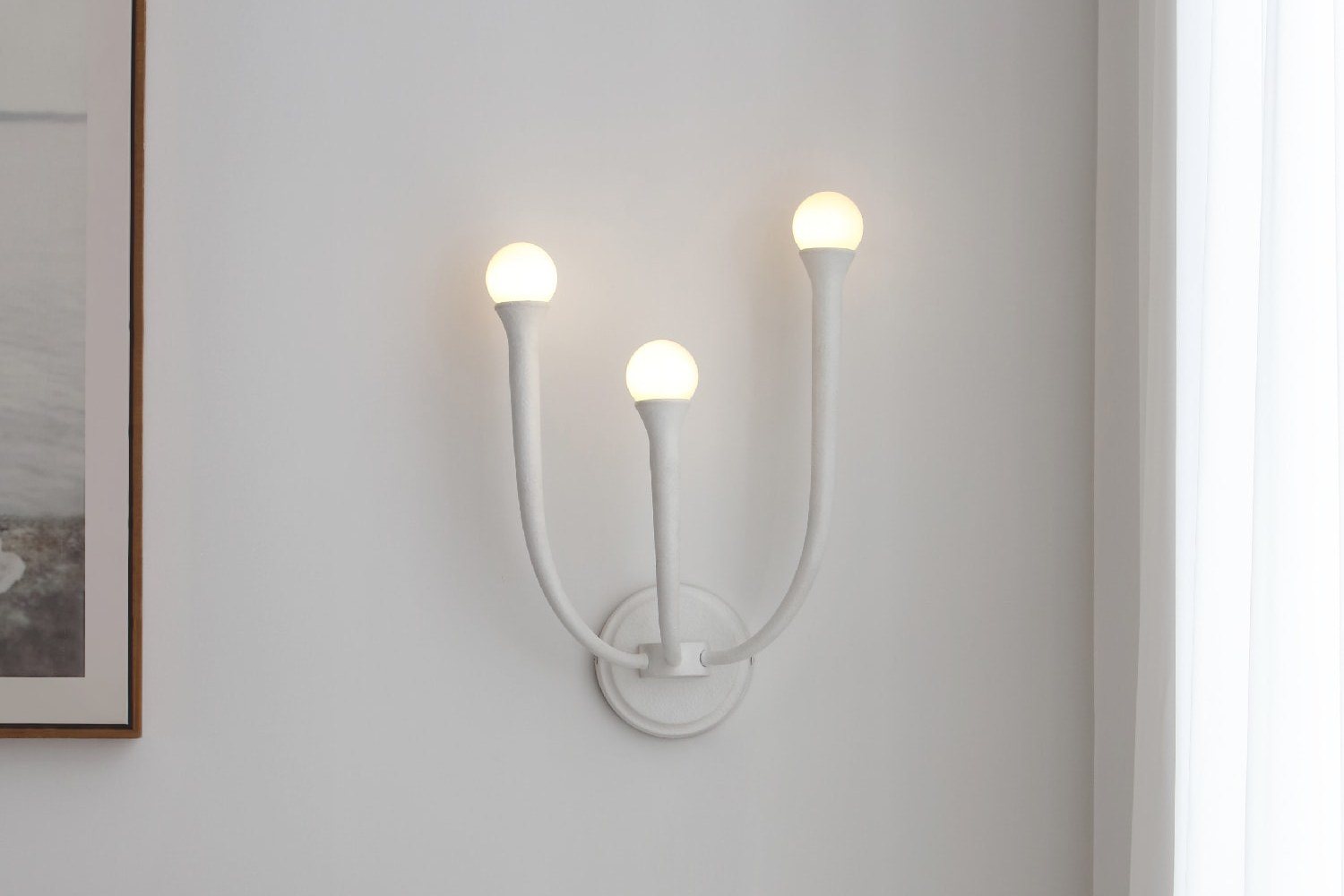
On a bulb-based sconce the fixture shapes the light and the bulb sets it: brightness and color temperature come from what you screw in. Buy both bulbs at once and identical, or a matched pair reads as two different colors across the bed.
Our guide to 2700K, 3000K, and 4000K covers which belongs in a bedroom. Integrated models settle it: the Alina 3 Light at 2700K and the Ma'or at 3000K, both dimmable.
Flanking art and fireplaces
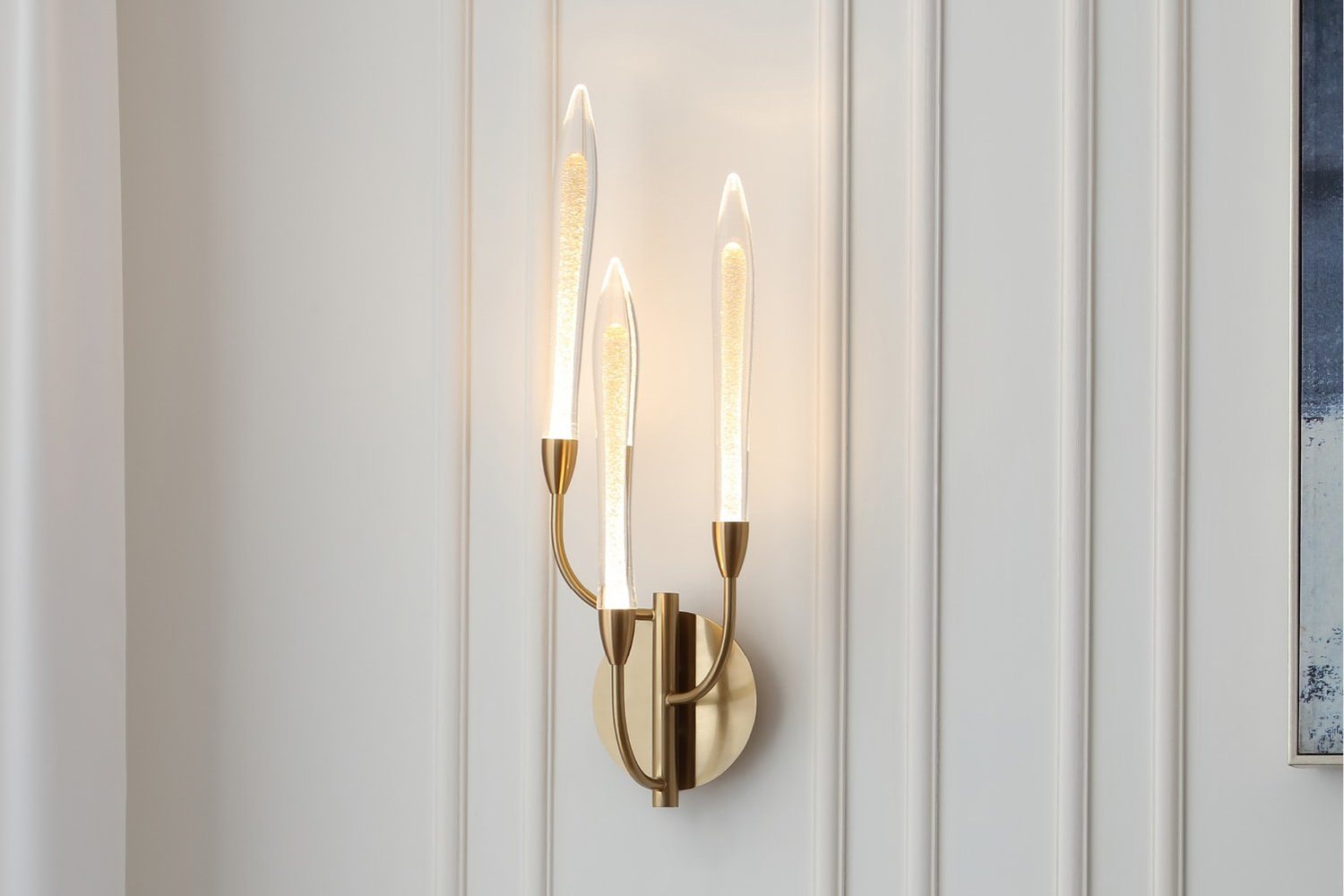
When a sconce frames something instead of lighting a task, the focal point sets the height. Center it on the upper half of the piece, 6 to 12 inches out, matched both sides.
Plug-in sconces: when there is no junction box
A hardwired sconce needs an electrical box at the exact spot you want it, and moving one means opening the wall and calling an electrician. That is where a lot of good sconce plans die.
The Ma'or and the Mazal are plug-in. They draw from an existing outlet, so there is no electrician, no opened wall, and the fixture comes with you when you move. The trade-off is the cord. It runs to the nearest outlet, and unless a nightstand hides it, you will see it.
Which VidaLite sconce fits where
| Where it is going | Look at | Why it fits |
|---|---|---|
| Bathroom, flanking a mirror | Nimbus 1 Light · Voyager 1 Light · Breeze 3 Light | ETL listed, IP44, so they also work anywhere dry. Nimbus and Voyager are single lamp, the simplest flanking pair, Nimbus on E12 and Voyager on E26. Breeze puts three lamps at each side position |
| Bedside | Ma'or · Mazal · Alina 3 Light | IP20, dry rated, all dimmable. No box: Ma'or plug-in at 3000K, Mazal plug-in on E26. Box already there: Alina at 2700K |
| Hallway or stair run | Aurelia 1 Light · Savannah 2 Light | Dry rated, E12 bulbs so you pick the light. Aurelia single lamp for an even run; Savannah two lamps at one position |
| Flanking art or a fireplace | Alina 3 Light · Splay 2 Light | Brass, both multi-lamp, so light spreads instead of dropping one hot spot. Alina integrated at 2700K; Splay takes E12 bulbs |
| Covered porch or exposed entry | Orion Outdoor Up/Down | IP66, wet rated, 3000K, ETL and cETL listed |
The rest of the wall sconce collection sorts the same two ways: how it is rated, and how it gets power.
In-stock VidaLite sconces leave US stock in 1 to 2 business days, with free 30-day returns on unused fixtures in their original packaging, so you can hold one to the wall and still change your mind.
Frequently asked questions
How high should wall sconces be mounted?
Center the fixture 60 to 72 inches above the finished floor, 66 inches by default under an 8 foot ceiling, plus about 3 inches per additional foot.
How far apart should wall sconces be spaced?
In a hallway, 8 to 10 feet apart, with the first fixture about 4 to 5 feet from the end wall. Beside a bathroom mirror the pair sits closer, 36 to 40 inches apart at 60 to 66 inches, because the job there is crossing light on a face.
How high should sconces be beside a bed?
Mount the pair so the light source sits 30 to 36 inches above the mattress top, aligned with the nightstands. Lower puts the lamp in your eyes when you sit up; higher spills light across the wall.
Can you put a wall sconce in a bathroom?
Yes, if it is rated for it. A bathroom is a damp location, so look for a damp or wet rating rather than a dry rated fixture, and step up to wet rated inside a shower. VidaLite's Nimbus 1 Light, Voyager 1 Light, and Breeze 3 Light are ETL listed and IP44 rated.
Do wall sconces need an electrical box?
Hardwired sconces do, and the box must sit at the height you want the fixture, so moving one is an electrician's job. Plug-in models such as the VidaLite Ma'or and Mazal draw from an existing outlet instead.
Ready to look? Measure first: height to the fixture center, not the box. If the wall has a box, start with the wall sconce collection, or the outdoor wall sconces for a covered porch or entry; if it does not, the plug-in Ma'or or Mazal. For client work, the trade program adds 15% trade pricing.